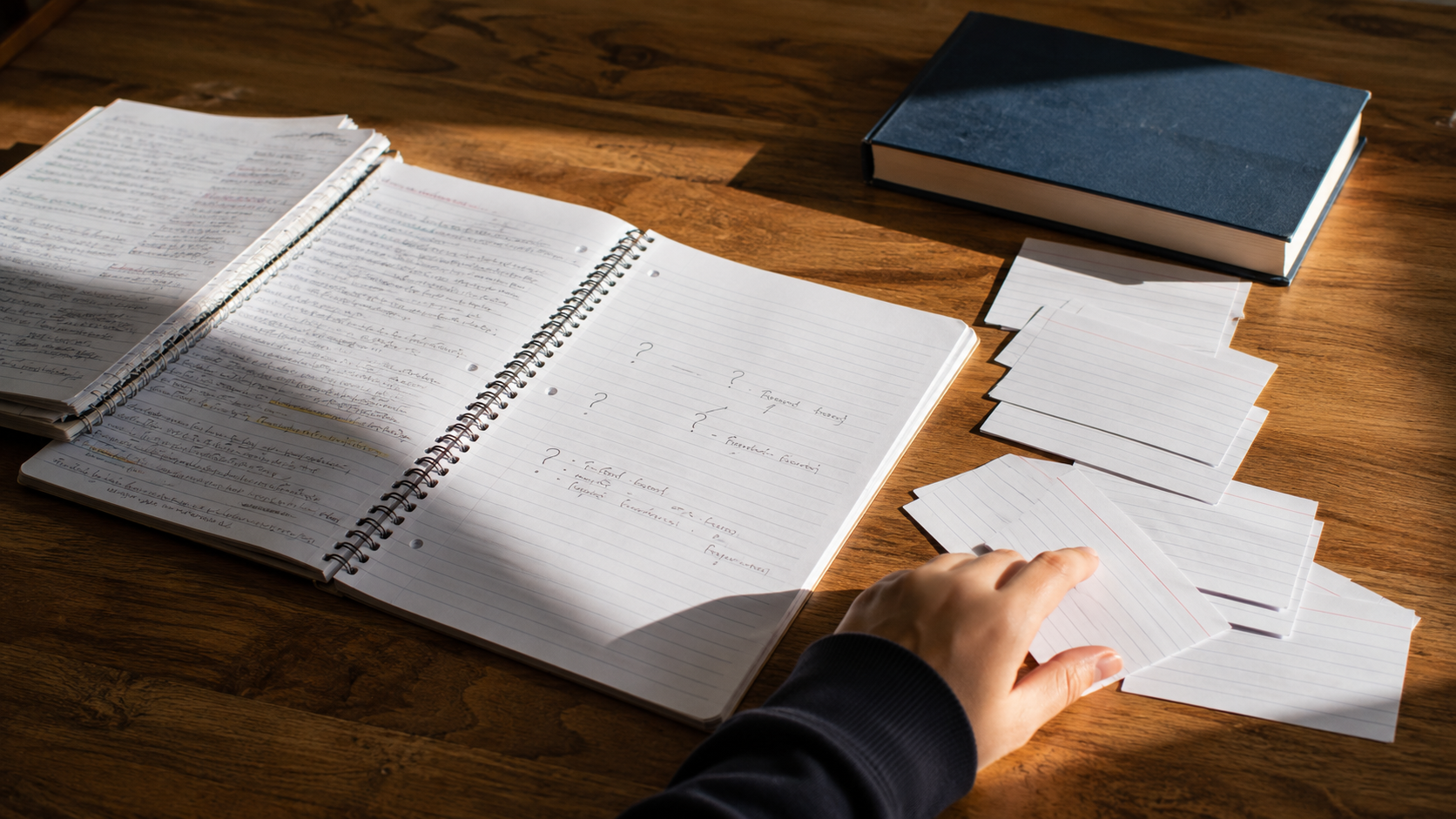
Re-reading your notes can feel productive but you need effective revision techniques. You sit down with a textbook or revision folder, work through pages of familiar material and finish the session feeling as though you have covered a substantial amount. The problem is that recognising information when it is sitting in front of you is not the same as being able to recall it when you need it.
This distinction becomes particularly important when preparing for GCSEs and A-levels. An examination does not usually ask whether information looks familiar. You need to retrieve knowledge, apply it to questions and, in many subjects, connect ideas from different parts of the course.
Understanding how to revise effectively can therefore make a significant difference to the value of the time you spend studying. Re-reading has a place, but relying on it as your main revision technique can create confidence without necessarily creating strong recall.
Why does re-reading feel so effective?
The problem with re-reading is that it becomes easier each time you do it.
On your first pass through a difficult page, some of the terminology may feel unfamiliar. By the third or fourth reading, the same sentences seem obvious. That growing familiarity can easily be interpreted as learning.
Unfortunately, familiarity is not the same as retrieval. When the notes disappear and you are asked to explain the topic yourself, you may discover that considerably less information is available from memory than you expected.
This is one reason revision can sometimes produce an unpleasant surprise. A learner can spend hours looking at course material and genuinely believe they know it, only to struggle when attempting a practice question without their notes or effective revision techniques.
The solution is not to stop reading altogether. It is to make sure reading is followed by activities that require you to do something with what you have learned.
What is active recall?
Active recall involves deliberately trying to retrieve information from memory rather than repeatedly looking at the answer.
Imagine you have just studied a section of A-level Biology covering cell membranes. Instead of immediately reading the same pages again, you could close the book and write down everything you remember about the topic. Afterwards, compare what you produced with your notes and identify what you missed.
Flashcards can use the same principle when they are used properly. The useful part is not reading the answer repeatedly. It is attempting to produce the answer before turning the card over.
Students taking online A-level courses can incorporate this approach throughout their studies rather than waiting until the final weeks before an examination. Regular retrieval helps revision become part of the learning process itself.
It can feel harder than re-reading because your brain has to work. That difficulty is part of what makes the exercise useful.
Why is testing yourself useful?
Testing yourself reveals the difference between what you recognise and what you can actually recall.
Suppose you read a page of notes and everything seems familiar. You may reasonably conclude that you understand it. If you then attempt five questions and cannot answer three of them, you have discovered something valuable before the examination rather than during it.
Self-testing also helps make revision more targeted. Instead of repeatedly reviewing an entire topic, you can concentrate on the specific areas that you struggle to retrieve or apply.
This works particularly well for subjects such as GCSE Maths, where understanding a worked example is very different from being able to solve a fresh problem independently. Practice exposes weaknesses that passive reading can hide.
Getting an answer wrong during revision is therefore not wasted effort. It gives you information about what to work on next.
What is spaced practice?
Another useful principle is spreading revision across time rather than concentrating everything into a small number of intensive sessions.
If you study a topic once and never return to it, some forgetting is inevitable. Revisiting the material periodically gives you repeated opportunities to retrieve and strengthen what you have learned.
The Learning Scientists highlight both retrieval practice and spaced practice among evidence-informed learning strategies. The two approaches work particularly well together because you can return to material at intervals and actively test what you still remember.
This does not require an elaborate revision system. You might study a topic this week, test yourself on it several days later and then return to it again after a longer interval.
The important part is that previous material continues to appear in your study schedule instead of disappearing as soon as you move to the next chapter.
Are flashcards actually useful?
They can be, but the way you use them matters more than the cards themselves.
A flashcard works best when one side creates a genuine question or prompt and you attempt to answer it before checking the other side. Simply flicking through cards and thinking "yes, I remember that" can recreate the same familiarity problem as re-reading notes.
Keep cards focused. Trying to squeeze an entire textbook page onto one card makes retrieval unnecessarily complicated. Definitions, processes, key facts and short explanations are often better suited to the format.
Flashcards are less useful for some forms of learning. Knowing individual facts will not automatically teach you how to construct an essay, evaluate an argument or solve a complex mathematical problem.
Revision methods should match what the examination actually requires you to do.
What about highlighting your notes?
Highlighting can help you identify important information when you first work through a text, but covering a page in fluorescent colour is not revision by itself.
If almost every sentence is highlighted, nothing has really been prioritised. More importantly, the act of highlighting does not necessarily require you to retrieve or apply information.
A better approach is to use highlighted material as the starting point for something more active. Turn key ideas into questions, create a short summary without looking at the original text or explain the concept aloud as though you were teaching it to somebody else.
For learners completing online GCSE courses, this can be particularly helpful because independent study gives you considerable control over how you revisit previous topics. Your notes become a resource for generating revision activities rather than the revision activity itself.
Does explaining a topic to someone else help?
Trying to explain an idea in your own words can quickly expose whether you genuinely understand it.
You do not actually need another person in the room. Choose a topic, put your notes away and explain it aloud as though you were teaching someone who had never encountered it before.
You will often notice the precise moment your understanding becomes uncertain. Perhaps you can describe what happens but not why it happens, or remember the overall concept but cannot recall an important term.
Those moments are useful. Return to your course materials, resolve the gap and then try explaining the topic again.
This technique can be particularly valuable for subjects that require extended explanations rather than simple factual recall.
When should you start doing practice questions?
Earlier than many learners think.
Practice questions are sometimes treated as something to save until the course has been completed. In reality, using them throughout your studies can help you understand how knowledge is likely to be assessed.
An exam question may require more than remembering a fact. You might need to interpret information, construct an argument, perform a calculation or apply knowledge to an unfamiliar situation.
This is why practising matters across subjects. Someone studying A-level Biology needs factual knowledge, but they also need experience applying biological concepts to the types of questions used in assessment.
You do not need to complete full examination papers from the beginning of the course. Individual questions and short sections can gradually introduce exam technique while reinforcing the material you are currently studying.
Is there ever a good reason to re-read your notes?
Yes. Re-reading is not useless.
If you have forgotten a topic almost entirely, you need to revisit the material before you can meaningfully test yourself on it. Reading can also help clarify something you misunderstood or provide context before you begin more active revision.
The problem arises when re-reading becomes the entire strategy.
A useful pattern is to review the material briefly and then close it. Try to recall the main ideas, answer questions or write a short explanation from memory. Afterwards, return to the notes and check what you missed.
In that sequence, reading supports retrieval rather than replacing it.
How can you build a better revision session?
You do not need to throw away your existing notes or create an elaborate new system. Start by changing what happens after you read them.
Spend a short period reviewing a topic, then remove the material from view and test yourself. Use questions, flashcards, a blank sheet of paper or a verbal explanation. Check your answers, identify gaps and focus the next part of the session on those weaker areas.
Over the following days and weeks, return to the topic and test yourself again. Mixing newer material with subjects you studied previously can help prevent older knowledge from quietly disappearing.
This approach can initially feel less comfortable than re-reading because it repeatedly confronts you with things you cannot remember. That is useful information, not evidence that the method is failing.
Effective revision should reveal weaknesses while you still have time to improve them.
Final thoughts on effective revision techniques
Re-reading notes feels productive because familiar material becomes increasingly easy to recognise. Unfortunately, an examination requires more than recognition.
You need to retrieve information when the answer is not sitting in front of you, and you often need to apply that knowledge in unfamiliar ways. Techniques such as active recall, spaced practice, self-testing and practice questions are designed to develop those abilities.
Your notes still matter. They contain the information you need to learn and provide something against which you can check your understanding. They simply should not do all the work.
The next time you finish reading a page of revision notes, close the book before reading it again. Ask yourself what you can remember without looking.
What happens next will tell you far more about your revision than another read-through ever could.