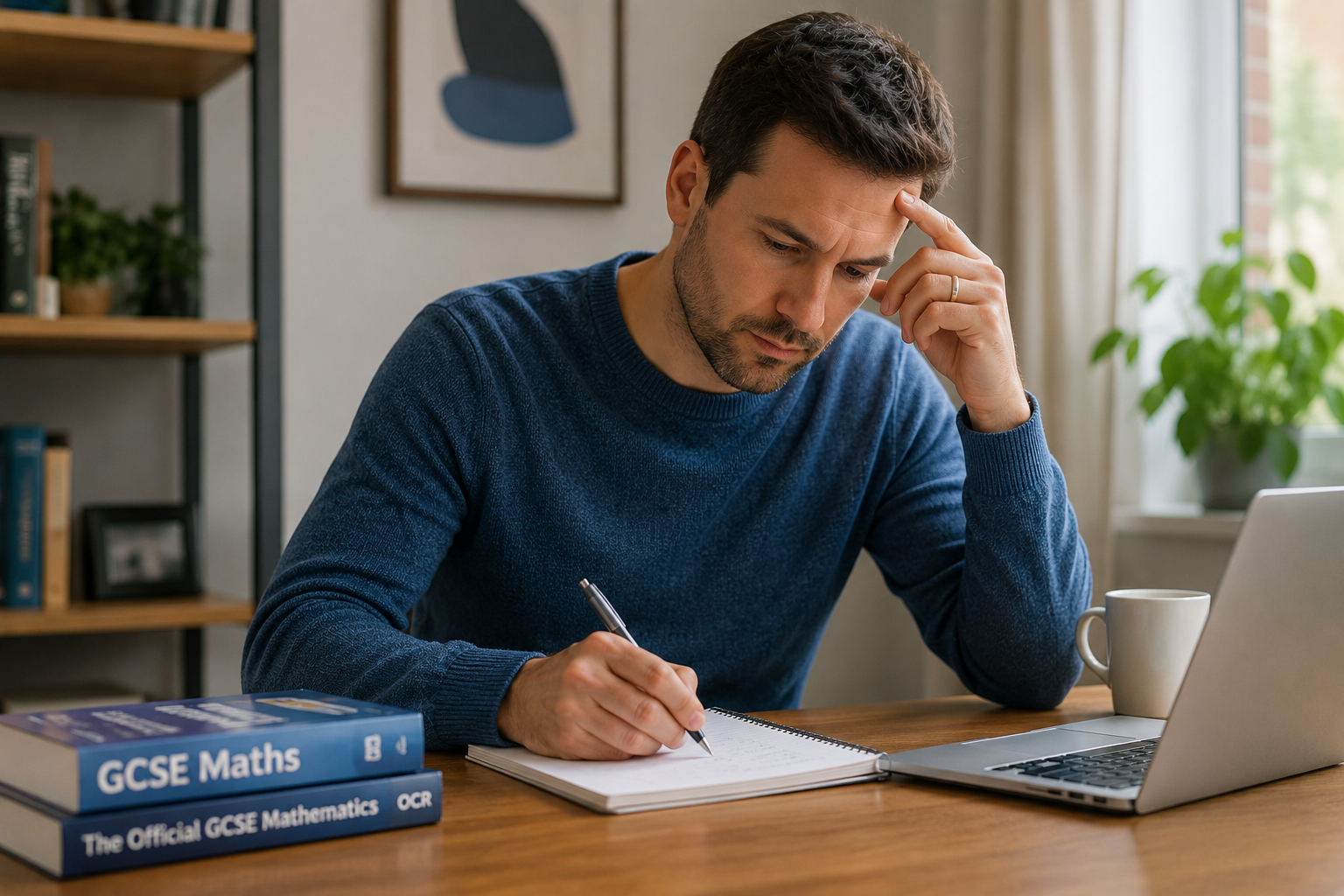
For many adults considering a return to education, GCSE Maths is often the qualification that causes the most anxiety. Even people who feel confident about studying again can feel uneasy at the thought of returning to maths, particularly if school memories involve confusion, frustration or poor exam results.
If you are asking whether GCSE Maths is hard as an adult, you are certainly not alone. It is one of the most common concerns among adult learners and one of the most understandable. Maths can feel intimidating, especially after years away from formal education.
The reassuring news is that while GCSE Maths can be challenging, many adult learners succeed, including plenty who once believed they were simply “bad at maths”.
Why does GCSE Maths feel intimidating?
Maths tends to create strong emotional reactions in a way that many other subjects do not. For some learners, difficulty with maths at school becomes part of how they see themselves, and those old experiences can shape confidence years later.
The challenge is often not just mathematical knowledge. It is the mindset that comes with it. Many adults return to study carrying assumptions such as “I have never been good at maths” or “I just do not have a mathematical brain”. In reality, these beliefs are often far more limiting than the subject itself.
Confidence can play an enormous role in how difficult maths feels.
Is GCSE Maths harder as an adult?
Not necessarily. In some ways, studying maths as an adult can actually feel easier than it did at school. Adult learners often bring greater patience, discipline and motivation to the learning process. You are also much more likely to understand why the qualification matters, which can make studying feel more purposeful.
At school, maths can sometimes feel abstract or disconnected from real life. As an adult, practical applications such as budgeting, percentages, measurements and problem-solving may feel more meaningful and easier to engage with. This change in perspective can make a significant difference.
What makes GCSE Maths challenging?
The difficulty of GCSE Maths usually comes down to three main areas. The first is the knowledge gaps. If foundational concepts such as fractions, percentages or algebra feel shaky, later topics can become harder to grasp.
The second is consistency. Maths is a subject where regular practice matters enormously. Long gaps between study sessions can slow progress because skills are built gradually over time.
The third is exam pressure. Many learners understand topics during revision but struggle to apply them confidently under timed conditions.
None of these challenges is insurmountable, but they do explain why steady progress matters so much.
Can online study help?
For many adults, yes. Flexible online GCSE courses can be especially helpful for maths because they allow learners to revisit difficult topics as often as needed. In a classroom, lessons move at a fixed pace, which can sometimes leave learners feeling left behind. Online study often removes that pressure.
Learners can pause, repeat and revisit explanations until concepts feel secure. This ability to work at your own pace can be particularly valuable in subjects that build progressively.
Strong tutor support also matters. A good provider should help explain difficult concepts clearly and provide guidance when learners feel stuck.
How can you improve your chances of success?
Success in maths rarely comes from natural talent alone. Consistent effort is usually far more important.
Organisations such as National Numeracy have highlighted how confidence and mindset influence mathematical progress, especially for adults returning to education. Improving your relationship with maths can be just as valuable as improving technical knowledge.
Small, regular study sessions often work better than occasional long sessions. Building a routine helps knowledge settle and reduces the feeling of overwhelm.
Progress in maths often feels slow until, suddenly, concepts begin to click.
Final thoughts
So, is GCSE Maths hard for adult learners?
It can be challenging, particularly if you are rebuilding confidence or revisiting topics you struggled with in the past. However, difficulty does not mean impossibility.
Many adult learners discover that GCSE Maths feels very different the second time around. With maturity, stronger motivation and the right support, success can become much more achievable than expected.
Being nervous about maths is completely normal. What matters most is not where you are starting from, but your willingness to keep moving forward.