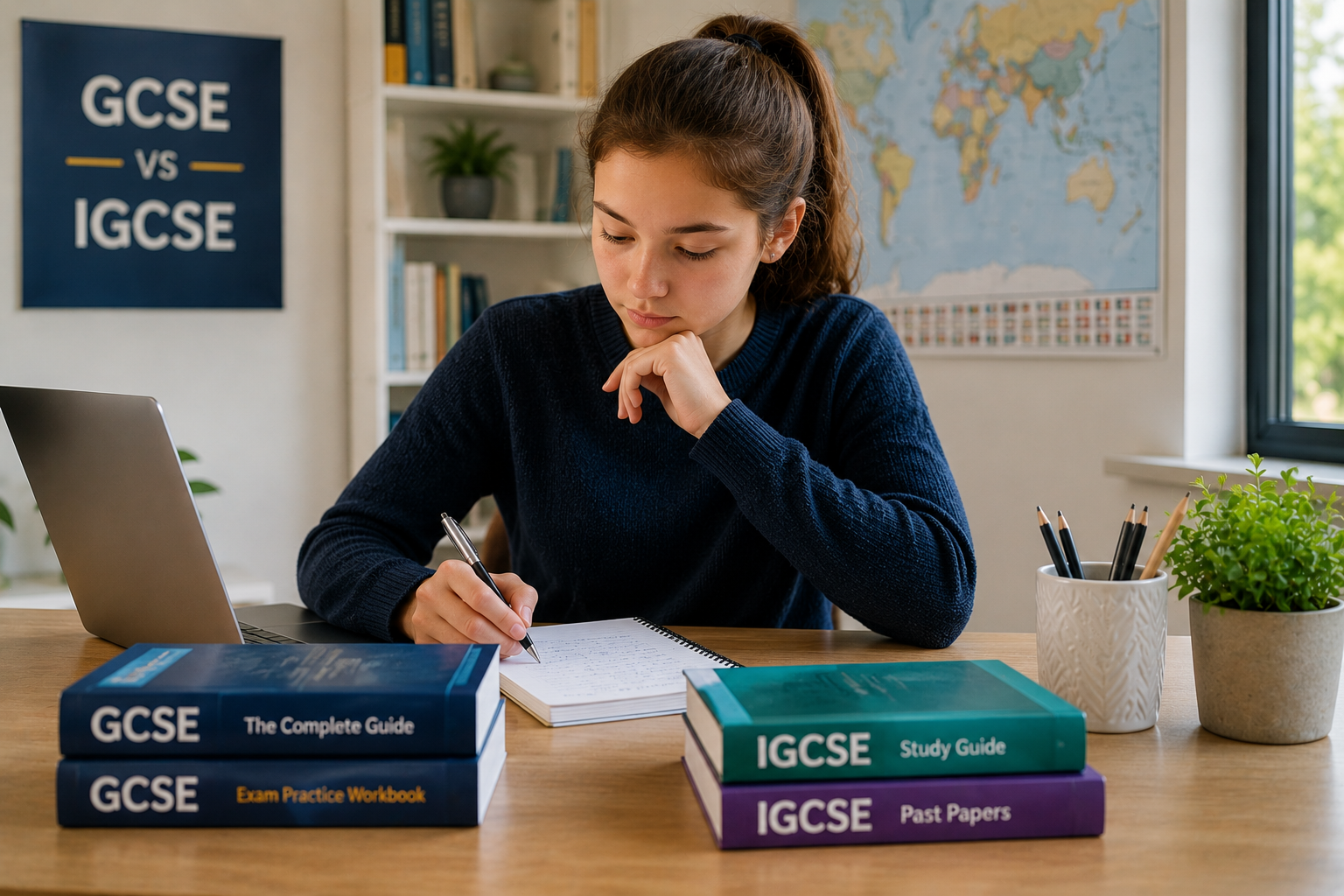
If you have been researching secondary school qualifications, you may have come across both GCSEs and IGCSEs and wondered what sets them apart. At first glance, they can appear very similar. Both are widely recognised qualifications studied at roughly the same academic level, and both can support progression into further education, training and employment.
Even so, there are some important differences in how they are structured and assessed. Understanding those differences can help you decide which route may be most suitable, particularly if you are choosing a course as an adult learner or supporting a child through qualification choices.
What is a GCSE?
A GCSE, or General Certificate of Secondary Education, is one of the most common qualifications studied by learners in England, Wales and Northern Ireland. GCSEs are usually taken by students aged 14 to 16 and form an important part of the UK education system.
Subjects typically include English, Maths and Science, alongside optional subjects such as History, Geography or Psychology. Many learners later use GCSE grades to progress to A-level study, vocational qualifications or apprenticeships.
For adult learners, GCSEs often become relevant when aiming to improve previous grades or meet entry requirements for further study.
What is an IGCSE?
An IGCSE, or International General Certificate of Secondary Education, is a qualification designed for an international audience, although it is also studied by some learners within the UK.
The qualification was developed by CAIE and is recognised by schools, colleges and universities around the world. While IGCSEs cover similar academic ground to GCSEs, the course structure and assessment methods can vary depending on the subject and exam board.
In practical terms, many learners find the academic standard broadly comparable to GCSE study.
How are GCSE and IGCSE different?
The biggest differences usually relate to course content and assessment style rather than academic difficulty.
Historically, IGCSEs were often seen as more exam-focused, with less coursework in certain subjects. Some specifications also placed a stronger emphasis on international perspectives, particularly in humanities subjects.
That said, the gap between the two qualifications has narrowed significantly over time. Reforms to GCSE assessment have made many GCSE courses more exam-based as well, meaning the practical differences are often smaller than people expect.
For many learners, the choice is less about one qualification being better and more about which course structure suits their circumstances.
Are both qualifications recognised?
Yes, both qualifications are widely recognised.
Regulated GCSE qualifications in England are overseen by Ofqual, helping to maintain consistent academic standards. IGCSEs offered through recognised exam boards are also widely accepted by employers, universities and colleges.
This means that in most situations, both GCSEs and IGCSEs are valid and respected qualifications. What matters most is usually the subject studied, the grade achieved and whether the qualification meets the entry requirements for your next step. Recognition is rarely the deciding factor between the two.
Which is harder?
This is one of the most common questions, but there is no simple universal answer.
Some learners perceive IGCSEs as slightly more demanding in certain subjects, particularly where assessments are heavily exam-based. Others find little meaningful difference between the two.
Difficulty often depends more on the subject itself, the exam board and the learner’s strengths than on whether the qualification is labelled GCSE or IGCSE. A qualification that feels challenging for one learner may feel very manageable for another.
Which qualification is better for online study?
For adult learners considering flexible education, the practical learning experience often matters more than the label of the qualification.
High-quality online GCSE courses can offer structured materials, tutor support and flexible study schedules that work well around busy lifestyles. Similarly, some learners may prefer online IGCSE programmes depending on subject availability and assessment preferences.
The most important consideration is often the course provider. Strong academic support, clear assessment guidance and transparent exam arrangements can make a much bigger difference to learner success than the specific qualification title.
Final thoughts
So, what is the difference between GCSE and IGCSE?
In simple terms, both qualifications sit at a similar academic level and are widely recognised, but they can differ slightly in content, assessment style and course structure. For most learners, the best choice depends less on prestige and more on personal goals, preferred learning style and future progression plans.
Whether you choose a GCSE or IGCSE, the right qualification is ultimately the one that supports your next step with confidence.